 Let's connect at gaiaadventures@shaw.ca
Catherine D'Aoust of GAIA Adventures Kinesiologist, Personal Training, Better Aging
http://www.gaiaadventures.com
GAIA hikes Diez Vistas on July 21; join me and other cool minded women
Let's connect at gaiaadventures@shaw.ca
Catherine D'Aoust of GAIA Adventures Kinesiologist, Personal Training, Better Aging
http://www.gaiaadventures.com
GAIA hikes Diez Vistas on July 21; join me and other cool minded women
Monday, June 25, 2012
Strength training 101 - part 3
We learned that the tension principle and overload principles are the first 2 principles in strength training. Here are the other two principles:
3. The Specificity of Training Principle: This refers to the fact that only the muscle or muscle group you exercise will respond to the demands placed upon it. By regularly doing bicep curls, for example, the muscles involved (biceps) will become larger and stronger, but curls will have no effect on the muscles that are not being trained (such as your legs). Therefore, when strength training, it is important to strengthen all of the major muscle groups.
4. The Detraining Principle: After consistent strength training stops, you will eventually lose the strength that you built up. Without overload or maintenance, muscles will weaken in two weeks or less! This is the basis behind why individuals lose muscle mass as they age—because they are detraining by exercising less frequently.
How Much Strength Training Should You Do?
When considering the guidelines for aerobic exercise, keep the FITT principles in mind (Frequency, (Intensity, Time and Type).
Frequency: Number of strength training sessions per week Aim to train each muscle group at least two times per week, and up to three if you have the time or are more advanced. One day per week may help you maintain your current level of strength, but in most cases, it will not be enough to build muscle. It is important to rest 1-2 days in between working the same muscle(s) again. Rest days give the muscles time to repair themselves from small tears that occur during strength training, and this is how you get stronger.
Intensity: How much weight or resistance you should lift This is a tricky one—and if you’re new to exercise, it will take some trial and error. The intensity of the resistance you lift should challenge you. It should be high enough that as you approach your last repetition, you feel muscle exhaustion. Exhaustion means your muscle is so tired that you can’t do another full repetition in good form.
Time: Number of reps and sets you should do Going from the starting position, through the action and back to the starting position counts as one rep. Most people lift somewhere between 8 and 15 reps, which equals one set. Most people do 1-3 sets with rest in between each set.
Make sure you rest 30-90 seconds between sets. You can use this time to stretch the muscle you are working and catch your breath or get a drink of water. The longer you rest, the more strength you will have to finish out your next set just as strongly as the previous one—which will aid in your strength development.
Type: Perform exercises to target every major muscle group when strength training: your arms (biceps and triceps), shoulders, chest, back, core (abs, obliques and lower back), and legs (quads, hamstrings, glutes and calves). Make sure you work opposing muscles, not just the ones you see when you look in the mirror (biceps, chest, abs, quads). The opposing muscles are the ones that work in opposition to those (in this case, the triceps, back, lower back, and hamstrings). Also be sure to work the sides of your body: obliques, hips, abductors and adductors (outer and inner thigh). The idea is to achieve balance.
In my next blog I will present tips on getting the most out of your strength training workouts. Happy training everyone!
(source: Jen Mueller and Nicole Nichols, Fitness Experts)
 Let's connect at gaiaadventures@shaw.ca
Catherine D'Aoust of GAIA Adventures Kinesiologist, Personal Training, Better Aging
http://www.gaiaadventures.com
GAIA hikes Diez Vistas on July 21; join me and other cool minded women
Let's connect at gaiaadventures@shaw.ca
Catherine D'Aoust of GAIA Adventures Kinesiologist, Personal Training, Better Aging
http://www.gaiaadventures.com
GAIA hikes Diez Vistas on July 21; join me and other cool minded women
Let's connect at gaiaadventures@shaw.ca
Catherine D'Aoust of GAIA Adventures Kinesiologist, Personal Training, Better Aging
http://www.gaiaadventures.com
GAIA hikes Diez Vistas on July 21; join me and other cool minded women

Monday, June 18, 2012
Strength training 101
4 Principles of Strength Training
The four principles of strength training are guidelines that will help you strength train safely and effectively to reach your goals.
1. The Tension Principle: The key to developing strength is creating tension within a muscle (or group of muscles). Tension is created by resistance. Resistance can come from weights (like dumbbells), specially-designed strength training machines, resistance bands, or the weight of your own body. There are three methods of resistance:
Calisthenics (your own body weight): You can use the weight of your own body to develop muscle, but using body weight alone is less effective for developing larger muscles and greater strength. However, calisthenics adequately improve general muscular fitness and are sufficient to improve muscle tone and maintain one’s current level of muscular strength. Examples include: pushups, crunches, dips, pull ups, lunges, and squats, just to name a few.
Fixed Resistance: This method of resistance provides a constant amount of resistance throughout the full range of motion (ROM) of a strength training exercise. This means that the amount of resistance/weight you are lifting does not change during the movement. For example, during a 10-pound curl, you are lifting 10 pounds throughout the motion. Fixed resistance helps to strengthen all the major muscle groups in the body. Examples include: Exercises that use dumbbells (free weights), resistance bands and tubes, and some machines.
Variable Resistance: During exercises with variable resistance, the amount of resistance changes as you move through the range of motion. This creates a more consistent effort of exertion throughout the entire exercise. For example, when lifting weights, it is harder to lift up against gravity and easier to lower the weight down with gravity. Specially-designed machines (like Nautilus and Hammer Strength brands) take the angle, movement, and gravity into account so that the release of a biceps curl feels just as hard as the lifting phase of the curl.
2. The Overload Principle: In order to build strength, your muscles must work harder than they are accustomed to. This “overload” will result in increased strength as the body adapts to the stress placed upon it. Everyone begins at a certain level of strength. To become stronger, you must regularly increase the tension (weight or resistance) that your muscles work against, causing them to adapt to a new level. As the muscles respond to an overload, they will grow in size and strength. There are two types of strength overloads:
Isometric means “same length.” This is a high-intensity contraction of the muscle with no change in the length of the muscle. In other words, your muscles are working hard but the muscle itself remains static. Isometric exercises are good for variety and some strength maintenance, but they don’t challenge your body enough to build much strength. Learn more about isometric exercise here.
Isotonic means “same tension.” When you lift weights or use resistance bands, your muscles are shortening and lengthening against the resistance. This challenges your muscles throughout the entire range of motion. However, the amount of force the muscle generates will change throughout the movement (Force is greater at full contraction/shortening of the muscle). Unlike isometric exercises, this type of contraction does help build strength.
(source: Jen Mueller and Nicole Nichols, Fitness Experts)
 In my next blog I will cover the other two strength training principles.
Let's connect at gaiaadventures@shaw.ca Catherine D'Aoust of GAIA Adventures Kinesiologist, Personal Training, Better Aging
http://www.gaiaadventures.com
GAIA hikes Diez Vistas on July 21; join me and other cool minded women
In my next blog I will cover the other two strength training principles.
Let's connect at gaiaadventures@shaw.ca Catherine D'Aoust of GAIA Adventures Kinesiologist, Personal Training, Better Aging
http://www.gaiaadventures.com
GAIA hikes Diez Vistas on July 21; join me and other cool minded women
 In my next blog I will cover the other two strength training principles.
Let's connect at gaiaadventures@shaw.ca Catherine D'Aoust of GAIA Adventures Kinesiologist, Personal Training, Better Aging
http://www.gaiaadventures.com
GAIA hikes Diez Vistas on July 21; join me and other cool minded women
In my next blog I will cover the other two strength training principles.
Let's connect at gaiaadventures@shaw.ca Catherine D'Aoust of GAIA Adventures Kinesiologist, Personal Training, Better Aging
http://www.gaiaadventures.com
GAIA hikes Diez Vistas on July 21; join me and other cool minded women
Monday, June 11, 2012
Strength Training 101
Every movement we make—from walking to driving—involves our muscles. Muscles are unique. They have the ability to relax, contract, and produce force. They are metabolically active, meaning that the more muscle you have, the more calories your body uses at rest and during exercise. Your muscles are highly responsive to strength training, which helps them to become larger and stronger. But if you don’t know anything about strength training, where do you start? Right here! In this and my next few blogs I will tell you everything you need to know to begin and even offer a few tips for experienced exercisers as well.
What is Strength Training? Strength training is the process of exercising with progressively heavier resistance for the purpose of strengthening the musculoskeletal system. It is also referred to as weight lifting, weight training, body sculpting, toning, body building, and resistance training.
What are the Benefits of Strength Training? Regular strength training increases the size and strength of the muscle fibers. It also strengthens the tendons, ligaments, and bones. All of these changes have a positive impact on your physical fitness, appearance, and metabolism, while reducing the risk of injury and decreasing joint and muscle pain. Muscle is metabolically-active tissue. This means that the more muscle you have, the faster your metabolism is while at rest. So, strength training is an important component of weight loss and weight maintenance.
Without consistent strength training, muscle size and strength decline with age. An inactive person loses half a pound of muscle every year after age 20. After age 60, this rate of loss doubles. But, muscle loss is not inevitable. With regular strength training, muscle mass can be preserved throughout the lifespan, and the muscle lost can also be rebuilt.
(source: Jen Mueller and Nicole Nichols, Fitness Experts)
 Let's connect at gaiaadventures@shaw.ca Catherine D'Aoust of GAIA Adventures Kinesiologist, Personal Training, Better Aging
http://www.gaiaadventures.com
GAIA hikes Diez Vistas on July 21; join me and other cool minded women
Let's connect at gaiaadventures@shaw.ca Catherine D'Aoust of GAIA Adventures Kinesiologist, Personal Training, Better Aging
http://www.gaiaadventures.com
GAIA hikes Diez Vistas on July 21; join me and other cool minded women
 Let's connect at gaiaadventures@shaw.ca Catherine D'Aoust of GAIA Adventures Kinesiologist, Personal Training, Better Aging
http://www.gaiaadventures.com
GAIA hikes Diez Vistas on July 21; join me and other cool minded women
Let's connect at gaiaadventures@shaw.ca Catherine D'Aoust of GAIA Adventures Kinesiologist, Personal Training, Better Aging
http://www.gaiaadventures.com
GAIA hikes Diez Vistas on July 21; join me and other cool minded women
Monday, June 4, 2012
Exercise with arthritis
Three of my personal training clients suffer from arthritis: a woman in her 50's, 70's and 80's. It can be very painful and demotivating. You just don't want to move anything when inflammation is present. But exercise can actually really help. Last week we covered flexibility and strength training. Today I will address Aerobic training (or cardio).
Aerobic Exercise
Weight-bearing activities like walking strengthen your bones, improve your balance and coordination, and help you maintain a healthy weight. In addition to these physical benefits, aerobic exercise helps improve your mood and reduces tension and stress. Aim for 3-4 sessions of aerobic exercise each week.
Try exercising in water. Water exercise is gentle on the joints since water acts as a cushion. Warm water also raises your body temperature, which causes your blood vessels to dilate, increasing circulation. ReadExercising in the Water for more details.
Try walking. Walking is an easy and safe way for people with arthritis to strengthen their muscles and joints. SparkPeople's Walking Guide will give you all of the tools you need to get started!
Avoid overdoing it. Although exercise has many benefits for people with arthritis, it is possible to do too much. Vigorous exercise that aggravates inflammation in the joints is harmful. If exercise-induced joint pain lasts more than two hours, you've done too much.
You and your doctor should work closely to come up with an exercise plan for you. Since each person is different with regards to arthritis type, degree of severity, and limitations, what works for one person might not work for another. That's why it is so important to talk to your doctor before starting an exercise program.
Starting a consistent exercise program will help manage your disease and reduce your risk of future problems. Arthritis and exercise go hand-in-hand, so get up and get moving!
 Let's connect at gaiaadventures@shaw.ca
Catherine D'Aoust of GAIA Adventures
Kinesiologist, Personal Training, Better Aging
www.gaiaadventures.com
Let's connect at gaiaadventures@shaw.ca
Catherine D'Aoust of GAIA Adventures
Kinesiologist, Personal Training, Better Aging
www.gaiaadventures.com
Let's connect at gaiaadventures@shaw.ca
Catherine D'Aoust of GAIA Adventures
Kinesiologist, Personal Training, Better Aging
www.gaiaadventures.com
Wednesday, May 23, 2012
Exercise with Arthritis
If you' live with the daily pain and discomfort of arthritis, you're not the only one. In the United States, an estimated 46 million adults (about 1 in 5) have been diagnosed with arthritis. Hopefully your doctor has given you suggestions about how to reduce the symptoms, lessen the debilitating effects, and improve your quality of life. One of these suggestions was probably to engage in regular physical activity. So how do you get motivated to go to the gym when you can't even get out of bed without pain? Is exercise really going to make a difference?
Research shows a positive relationship between arthritis and exercise:
A 14-year study published in Arthritis Research and Therapy, analyzed aerobic exercise and its impact on joint pain. Researchers found that exercise was associated with a substantial and significant reduction in pain, among men and women of various shapes and sizes.
A 2003 study published in the Journal of Arthritis and Rheumotology found that patients with RA (rheumatoid arthritis) can safely improve their level of physical fitness using a regular strength and endurance training program. Long-term studies have shown that people with inflammatory arthritis can benefit from moderate weight-bearing activity, and reduce the bone loss and small joint damage associated with this condition, wthout increasing pain or disease severity.
According to a study in the Journal of the American Medical Association, strength training can help people with arthritis preserve bone density and improve muscle mass, strength and balance.
If you have arthritis, three different kinds of activity should be incorporated into your exercise program: flexibility training, strength training and aerobic exercise. That may seem like a lot, but once you get into a routine and notice the benefits each provides, it will become a normal part of your everyday life.
In my next blog I will present exercise ideas to help you be healthy and active. Check out http://www.arthritis.ca "The Arthritis Society website" for more information.
 Let's connect at info@gaiaadventures.com.
Catherine D'Aoust at GAIA Adventures, Kinesiologist, Workshops
www.gaiaadventures.com
Let's connect at info@gaiaadventures.com.
Catherine D'Aoust at GAIA Adventures, Kinesiologist, Workshops
www.gaiaadventures.com

Tuesday, May 15, 2012
Kayak for fitness and fun
Imagine yourself seated at water level, in a narrow cockpit, legs pressed out to the sides to stabilize your boat, and you are beginning to get the idea of kayaking. You need to engage your core and back muscles to paddle effectively. You turn the boat with your rudder and your paddle. You can go as fast or as slow as you like.
The paddle is light, made from aluminum or fiberglass, with two blades on each end, spanning about 210 to 240 cm long. You need to orient it in the correct direction for effective paddling (the paddle blade has a name on it). You also need to hold the paddle gently (no death grip) with your elbows bent at your side. The rudder is like a tail-surface that you can extend and retract. You control the rudder with your feet using a system of pedals and cables.
On the water, it’s quiet and sublime; swimming seals pop up next to you, wanting to play. There are shores to hug and explore, colourful starfish to marvel at, and if you are lucky, you will be see the jellyfish drift by you as you glide along the surf. Designed to remain stable, a kayak does not easily tip over (especially the heavy plastic ones).
There are hidden dangers that you should be aware of: cold water (a forced plunge in water below 8 C can provoke hypothermia within minutes), tides and currents (currents between 1 to 4 knots are average, kayakers maintain an average speed of 3 knots) wind (has a drift effect) and weather. I highly recommend that you learn how to perform a rescue and self-rescue by taking a course. I booked a private lesson with Ecomarine and I am now confident in my skills and abilities.
Contrary to popular belief, you cannot roll an ocean kayak very easily. Also it requires good strength and endurance to be able to perform a self-rescue.
 There are many wonderful kayaking companies and tours out there to try: Ecomarine (Jericho and Granville Island) Deep Cove Kayaking and Rocky Point Kayaking. GAIA Adventures is offering an introduction to kayaking, women only, in Rocky Point Inlet (sheltered and fabulous) www.gaiaadventures.com. See you out there.
Catherine D’Aoust, GAIA Adventures Fitness and Adventures for Women, www.gaiaadventures.com
There are many wonderful kayaking companies and tours out there to try: Ecomarine (Jericho and Granville Island) Deep Cove Kayaking and Rocky Point Kayaking. GAIA Adventures is offering an introduction to kayaking, women only, in Rocky Point Inlet (sheltered and fabulous) www.gaiaadventures.com. See you out there.
Catherine D’Aoust, GAIA Adventures Fitness and Adventures for Women, www.gaiaadventures.com

Monday, May 7, 2012
Exercises for low back health
The following exercises have been chosen to spare the spine, enhance the muscle challenge and enhance the motor control system to ensure that spine stability is maintained in all other activities. Having stated this, they are only examples of well-designed exercises and may not be for everyone—the initial challenge may or may not be appropriate for every individual nor will the graded progression be the same for all clients. These are simply examples to challenge the muscles of the torso.
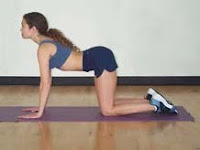
Cat-Camel (or Cow)
The routine should begin with the cat-camel motion exercise (spine flexion-extension cycles) to reduce spine viscosity (internal resistance and friction) and “floss” the nerve roots as they outlet at each lumbar
level. Note that the cat-camel is intended as a motion exercise—not a stretch—so the emphasis is on motion rather than “pushing” at the end ranges of flexion and extension. Repeat Five to eight cycles.

 Curl-up
The cat-camel motion exercise is followed by anterior abdominal exercises, in this case the curl-up. The hands or a rolled towel are placed under the lumbar spine to preserve a neutral spine posture. Do not flatten the
back to the floor. Flattening the back flexes the lumbar spine, violates the neutral spine principle and increases the loads on the disc and ligaments. One knee is flexed but the other leg is straight to lock the pelvis-lumbar
spine and minimize the loss of a neutral lumbar posture. Alternate the bent leg (right to left) midway through the repetitions.
Curl-up
The cat-camel motion exercise is followed by anterior abdominal exercises, in this case the curl-up. The hands or a rolled towel are placed under the lumbar spine to preserve a neutral spine posture. Do not flatten the
back to the floor. Flattening the back flexes the lumbar spine, violates the neutral spine principle and increases the loads on the disc and ligaments. One knee is flexed but the other leg is straight to lock the pelvis-lumbar
spine and minimize the loss of a neutral lumbar posture. Alternate the bent leg (right to left) midway through the repetitions.
 Birddog
The extensor program consists of leg extensions and the “birddog.” In general, these isometric holds should last no longer than seven to eight seconds given recent evidence from near infrared spectroscopy indicating
rapid loss of available oxygen in the torso muscles when contracting at these levels; short relaxation of the muscle restores oxygen. The evidence supports building endurance with increased repetitions rather than extending time.
Birddog
The extensor program consists of leg extensions and the “birddog.” In general, these isometric holds should last no longer than seven to eight seconds given recent evidence from near infrared spectroscopy indicating
rapid loss of available oxygen in the torso muscles when contracting at these levels; short relaxation of the muscle restores oxygen. The evidence supports building endurance with increased repetitions rather than extending time.
 Reference: "Enhancing Low-back Health through Stabilization Exercise", By Stuart M. McGill, Ph.D.,
Professor (Spine Biomechanics), University of Waterloo
Let's connect at info@gaiaadventures.com.
Catherine D'Aoust at GAIA Adventures, Kinesiologist, Workshops
www.gaiaadventures.com
Reference: "Enhancing Low-back Health through Stabilization Exercise", By Stuart M. McGill, Ph.D.,
Professor (Spine Biomechanics), University of Waterloo
Let's connect at info@gaiaadventures.com.
Catherine D'Aoust at GAIA Adventures, Kinesiologist, Workshops
www.gaiaadventures.com
Subscribe to:
Posts (Atom)